Built to Meet Builder's Risk Surveillance Requirements
Frontline solar camera trailers are built to meet or exceed the electronic surveillance standards that builder's risk insurers commonly require.
What Builder's Risk Insurers Look For
Many builder's risk policies now require an approved electronic surveillance system before coverage is issued. Insurers describe it as a comprehensive system arranged to promptly dispatch appropriate responders to abnormal conditions such as intrusion, along with a complete perimeter fence and adequate site lighting.
A Frontline trailer brings real-time AI detection, infrared night vision, live talk-down and siren/strobe deterrence, and live monitoring from our own security operations center in the United States, all on one self-contained solar unit. It meets stringent builder's risk requirements for camera specs, monitoring hours, and insurance documentation.
Request a Coverage Map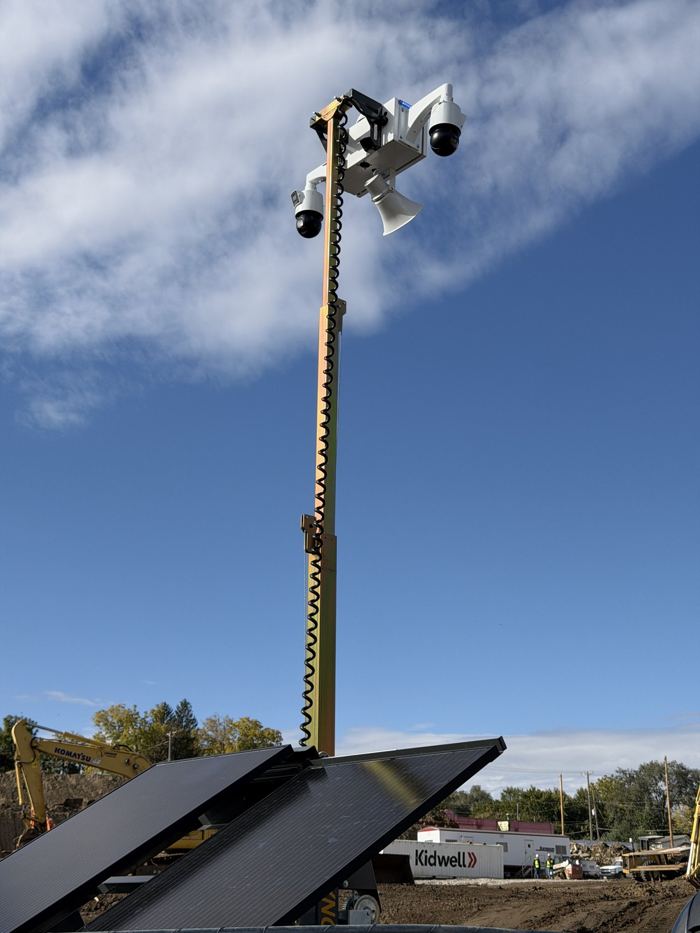
Requirement by Requirement
Common builder's risk surveillance requirements, and how Frontline meets them. Every requirement is met or exceeded, and we'll document it for your insurer.
| Typical builder's risk requirement | How Frontline meets it | Status |
|---|---|---|
| The system provider prepares a Security Vulnerability Assessment (SVA) as the basis of design for the surveillance system. | We deliver, set up, and program every trailer. Our site coverage map serves as the security assessment and basis of design for your project. | Meets / exceeds |
| The monitoring center is in North America, owned and operated by the vendor, and UL certified. | Live monitoring and dispatch come from our UL-certified security operations center in the United States. | Meets / exceeds |
| Monitoring happens at all times after hours, with a pre-determined schedule that automatically arms the system as a back-up. | Live remote monitoring at all times after hours, backed by an automatic arming schedule. | Meets / exceeds |
| The system detects and distinguishes all threats along the site perimeter in real time, including in low light with IR-equipped cameras or thermal imaging, using intelligent analytic detection software. | Customized AI analytics flag real threats and trigger real-time alerts. 333 ft infrared night vision, plus 360° PTZ cameras with 25x optical zoom and auto guard tours. | Meets / exceeds |
| A minimum of 4 camera stations (one at each corner) on a standard square or rectangular site, or 3 on uniquely shaped tracts. | Each trailer carries 4 IP cameras (2 PTZ plus 2 static) on a 20 ft mast. We deploy as many trailers as needed to cover all four corners, with multi-trailer discounts. | Meets / exceeds |
| A live audible voice interface to warn off intruders, and an on-site siren/strobe system. | Real-time talk-down speaker, siren and red/blue strobes. | Meets / exceeds |
| A battery backup power source that can run the system for at least 4 hours. | 100% solar powered, with on-board battery backup that runs the system for 4+ hours. No outside power needed. | Meets / exceeds |
| Daily health status checks confirm all components are working and the field of view hasn't been misaligned. | Daily health checks confirm all components are working and the cameras are aimed correctly. PTZ cameras are re-aimed remotely as the site changes. | Meets / exceeds |
| High-crime areas: a watchman service patrols the interior and exterior perimeter during non-working hours. | Roving patrol add-on: free alarm responses and one roving patrol per night to physically and visually check fencing and/or locks, which meets the watchman requirement. | Meets / exceeds |
The perimeter fencing, privacy screening, and site lighting that policies call for are usually the general contractor's responsibility. Requirements differ by policy, so always check your own policy documents.
Need Documentation for Your Insurer?
We can provide signed agreements, site coverage maps, and camera plans for your builder's risk file.